

NOT IN OUR NAME! Thirty Years After the Limit Hill Youth Love March
February 1996 - February 2026
Thirty years ago, a group of young people from Limit Hill refused to allow fear, violence and a newspaper headline to define their community.
They chose another way. They chose LOVE.
There are some old photographs that do more than remind you of what you looked like. They remind you of who you were.
And sometimes, if you sit with them long enough, they begin asking you uncomfortable questions about who you have become.
I have been sitting with some photographs and yellowing newspaper cuttings from February 1996.
Thirty years.
And suddenly I can hear the basketballs bouncing again. I can see the youngsters gathering at the Limit Hill Community Library on a Friday evening. I can hear the laughter. I can remember the dreams.
And I can remember the fire.
THE HEADLINE
On Friday, 9 February 1996, the Ladysmith Gazette carried a frightening front-page headline: “Limit Hill gang terror.”
The report spoke about the activities of a handful of wayward young people and the fear gripping sections of our community.
One of the young men caught up in that troubled period was Rudolph Carey. Thirty years later, I know another Rudolph Carey.
Rudi is today a reformed, Christ-following businessman and benefactor whose life reminds me that God never allows the headline written over somebody’s yesterday to have the final word over their tomorrow.
That, however, is another beautiful story still being written.
Because what the headline could never adequately capture was that, in the very same community, another group of young people was gathering every Friday.
We were the Limit Hill Youth Group. Many of us were also members of Panthers Basketball Club.
While some young people were being swallowed by the streets, others were meeting at the community library, attending youth, playing basketball, travelling to tournaments and discovering a world beyond the boundaries of our neighbourhood.
We were by no means perfect. We had our own struggles. We came from ordinary homes. We were growing up in a country barely two years into its democracy.
But when we saw our community being defined by gangsterism, something rose inside us.
Collectively, we said:
NOT IN OUR NAME!
And then we did something rather audacious. We decided we were going to march.
Not a march of anger. Not a march of revenge. Not a march looking for somebody to fight.
A LOVE MARCH.
We built a float. We made banners. We organised ourselves.
And on a busy Saturday, at one of the busiest times of the day, the youth of Limit Hill came down Murchison Street, through the heart of Ladysmith.
We called it our Valentine’s Street Parade. Our message was simple: LOVE.
Love for one another. Love across racial barriers. Love for our community. Love strong enough to say that violence would not have the final word.
The Mayor was unable to receive us, but the Town Secretary at the time, Mr Andries van Eck, met us. And we handed over our memorandum.
THE LETTER WE WROTE
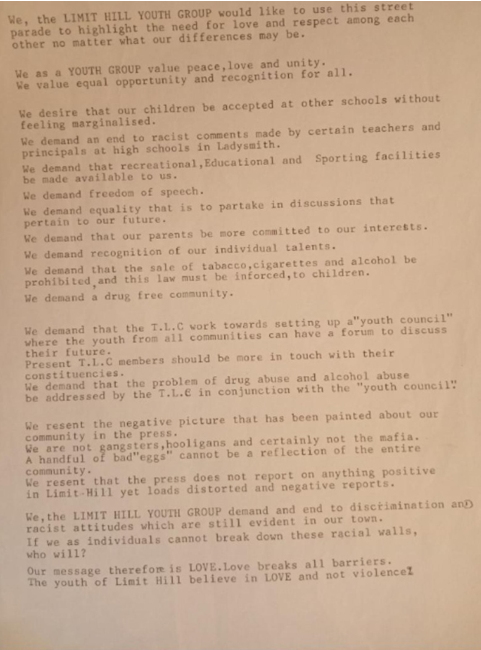
The original typewritten Limit Hill Youth Group memorandum - preserved as it was written in 1996.
Looking at it thirty years later makes me smile.
There was no communications department. No public-relations consultant. No beautifully designed presentation.
Just young people with a typewriter, some convictions and enough courage to believe that somebody ought to listen to us.
“We, the LIMIT HILL YOUTH GROUP would like to use this street parade to highlight the need for love and respect among each other no matter what our differences may be.”
“We as a YOUTH GROUP value peace, love and unity.”
“We, the LIMIT HILL YOUTH GROUP would like to use this street parade to highlight the need for love and respect among each other no matter what our differences may be.”
“We as a YOUTH GROUP value peace, love and unity.”
And then came our demands.
We wanted our children accepted at schools without feeling marginalised. We wanted racism in schools to end. We wanted recreational, educational and sporting facilities. We wanted freedom of speech. We wanted equality.
We wanted parents to become more committed to their children’s interests. We wanted our individual talents recognised. We wanted tobacco, cigarettes and alcohol prohibited from being sold to children. We wanted a drug-free community.
We wanted young people to have a voice in decisions concerning their future. We wanted the youth to be represented on civic structures.
We rejected gangsterism. We rejected mafia-style behaviour. We rejected the collection of so-called “bad debts” through intimidation. We rejected racism.
And near the end of that document we wrote words which almost leap off the old page thirty years later:
“Our message therefore is LOVE. Love breaks all barriers.”
My goodness. We were young. We did not realise how prophetic that little typewritten document would become.
THIRTY YEARS LATER...
South Africa has just commemorated the 70th anniversary of the historic 1956 Women’s March, when approximately 20,000 women marched to the Union Buildings. Their courage still speaks.
But somewhere in the much smaller history of our little town is another march that deserves remembering.
A march by young people. A march by children of a fledgling democracy. A march by youngsters from Limit Hill who looked at what was happening around them and decided: This cannot be our future.
Thirty years later, many of us who marched that Saturday are now in our late thirties, forties and fifties. We have jobs. Businesses. Families. Churches. Professions. Contacts. Experience. Resources. Influence.
Some of us have travelled the world. Some of us have achieved things that the young people walking down Murchison Street that Saturday could scarcely have imagined.
And so I want to ask my old Limit Hill Youth family a question:
What happened to our fire?
What troubles your spirit today? What injustice do you see today that the younger version of you would have refused simply to walk past?
When did some of us become too busy, too tired, too comfortable or perhaps too disappointed to believe that we could still change something?
Because the painful truth is this: many of the things that young people typed into that memorandum thirty years ago have not disappeared. Some have become even greater challenges for the generation following us.
And our old community library - the place where so many of us gathered - is no longer there.
That hurts. Because we understand something today that perhaps we did not fully understand then.
WE THOUGHT WE WERE JUST HAVING FUN.
We thought we were just going to youth on Friday nights. We thought we were just playing basketball. We thought we were just climbing into vehicles and travelling to another town to play a game. We thought we were simply laughing with friends.
But something much deeper was happening.
We were being protected.
Every Friday evening spent at youth was an evening we were not somewhere else. Every hour spent chasing a basketball around a court was an hour in which the streets did not have us.
Every adult who gave up an evening, transported a team, coached a youngster, opened a church hall, unlocked a library or simply listened to us was quietly increasing our chances of making it through.
We didn’t know it then. We know it now.

The Valentine’s Street Parade - the youth of Limit Hill answering fear with love, unity and hope.
Recently I showed that old Gazette front page to one of my former players and youth members, Ashley, who is now a pastor.
He looked at it and said something that stopped me:
“Wow! I didn’t even realise it was that bad then. We were probably at the court playing basketball or at youth; that’s why I don’t remember it so well.”
Ashley, you may have just preached an entire sermon in one sentence.
“We were probably at the court playing basketball or at youth...”
That was it.
While danger existed around us, somebody had created somewhere else for us to be.
Somewhere safe. Somewhere positive. Somewhere we belonged. Somewhere somebody knew our names. Somewhere somebody expected us to arrive.
And perhaps that made all the difference.
SO, WHERE ARE THEY NOW?
Not the young people of 1996. The young people of 2026.
Where is their basketball court? Where is their Friday night youth meeting? Where is their community library? Where is the adult who knows their name? Where is the person who notices when they don’t arrive?
Where is the vehicle taking them to see another town, another province, another possibility?
Where is the coach? Where is the youth leader? Where is the mentor?
Where is the person telling a child growing up amid difficult circumstances: “Your surroundings do not have the authority to decide your destination.”
Thirty years ago, we demanded that somebody do something for the youth.
Thirty years later, perhaps we need to recognise something rather uncomfortable.
WE ARE NOW THE SOMEBODIES.
The memorandum has come back to us. The baton is in our hands.
TO EVERYONE WHO WALKED WITH US THAT DAY...
If you recognise yourself in these photographs... If you remember that float... If you remember Murchison Street... If you remember Panthers Basketball... If you remember Friday nights at the library... If you remember those youth meetings... If you remember travelling to play basketball... If you remember the adults who sacrificed their time for us...
Then I want you to do something.
Don’t merely say: “Those were good days.” Ask yourself: Why were they good days?
And then ask the harder question:
WHO AM I CREATING GOOD DAYS FOR NOW?
Look around you.
There is a boy somewhere who needs somebody to believe in him. There is a girl somewhere whose world needs to become bigger than the street on which she lives. There is a teenager who needs somewhere positive to be on a Friday night.
There is a child who needs a coach. A lift. A book. A meal. A pair of takkies. A basketball. A listening ear. An opportunity. A word of encouragement. A role model.
Perhaps you do not need to start an organisation. Perhaps you simply need to notice one young person.
Because somebody once noticed us.
Before you finish reading this, I want you to look carefully at these old photographs. Find the young face that once belonged to you. Remember that person. Remember their dreams. Remember their courage. Remember how little they had compared with what you have today.
And then ask that younger version of yourself:
“If you had my contacts, my resources, my experience, my finances and my influence, what would you do for the children of Limit Hill today?”
Then take that question to God.
Because perhaps this thirty-year anniversary is not really about nostalgia. Perhaps it is a summons.
Perhaps Jesus is calling the old Limit Hill Youth Group together again - not necessarily into the same building, not necessarily onto the same basketball court and not necessarily for another march down Murchison Street.
But back to the same spirit of service. Back to believing. Back to praying. Back to loving. Back to sharing. Back to noticing young people before the streets notice them.
Thirty years ago we marched because we refused to allow violence to define our community. Today I believe we are being called to march again.
Maybe not with our feet this time. Maybe with our Testimony. Our Time. Our Talent. Our Treasures.
Thirty years ago, we were asking adults to help us build a better future.
Today... WE ARE THE ADULTS.
And somewhere, another generation is waiting.
May we never become so successful that we forget the people who gave us a chance to become successful. May we never become so busy that we forget the adults who once made time for us.
May we never look at a troubled young person and write them off, because the story of Rudolph Carey reminds us that a frightening headline is not a life sentence.
And may we never forget the words of a group of idealistic young people, hammered out on a typewriter in Limit Hill thirty years ago:
“OUR MESSAGE THEREFORE IS LOVE.” “LOVE BREAKS ALL BARRIERS.”
The paper has yellowed. The library may be gone. The basketball games have ended. The young people in those photographs have grown older.
But the message has not aged.
Believe. Pray. Love. Share.
And maybe... just maybe... it is time for the Limit Hill Youth to march again.
“Do not be overcome by evil, but overcome evil with good.” - Romans 12:21 (NIV)